
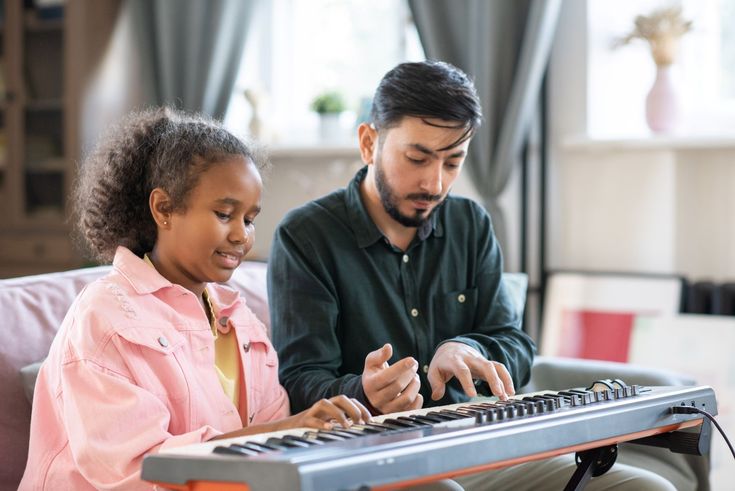
Enjoy this story from our instructor, Kyle!
“Before I even met them, I’d been told to expect challenges with two brothers I was about to begin teaching. Their mother, like many parents, carried a mix of hope and hesitation. She worried that one of her boys wouldn’t be able to sit still long enough for music lessons, let alone thrive in them.
It’s a concern I hear often and not without reason. Children are naturally full of energy, curiosity, and sometimes a sense of restlessness. But what many parents don’t realize is that these qualities can be the very fuel for musical growth, provided they’re given the right environment.
From the very first lesson, something unexpected happened. The boy who was predicted to struggle didn’t resist the piano at all. The moment he sat down, he settled. His body language shifted; his eyes focused; his mind engaged. It was as if the piano itself had permitted him to anchor his energy in one place.
We didn’t stay confined to the method book. We stepped into sound exploration, how a major interval feels different from a minor one, how a certain chord can spark an image or a memory. He wasn’t just following instructions; he was making sense of music in a way that was his own. That depth of engagement wasn’t accidental. It came from meeting him where he was, giving him space to think, to imagine, to connect dots his mom never thought he’d notice.
This is the quiet power of music education that often goes unseen. For some children, music lessons aren’t just about discipline or technical skill. They’re about finding a focus point, a channel through which their natural energy can turn into curiosity, discovery, and growth.
And that is the kind of space we aim to create: not one-size-fits-all, but an environment where children feel safe to explore, grounded enough to focus, and inspired enough to keep coming back to the piano not because they ‘should’, but because something inside them lights up when they do.”